Sole Trader, Partnership, Company or Trust? Choosing the Right Business Structure
Most people starting a business spend a week on the name and ten minutes on the structure. It should be the other way round. The structure decides who pays the tax, who is on the hook if something goes wrong, what it costs to run each year, and how hard it is to sell or bring in a partner later.
There are four main options in Australia: sole trader, partnership, company and trust. None of them is "best". The right one depends on your risk, your profit, who owns the business and where you want it to go.
Sole trader
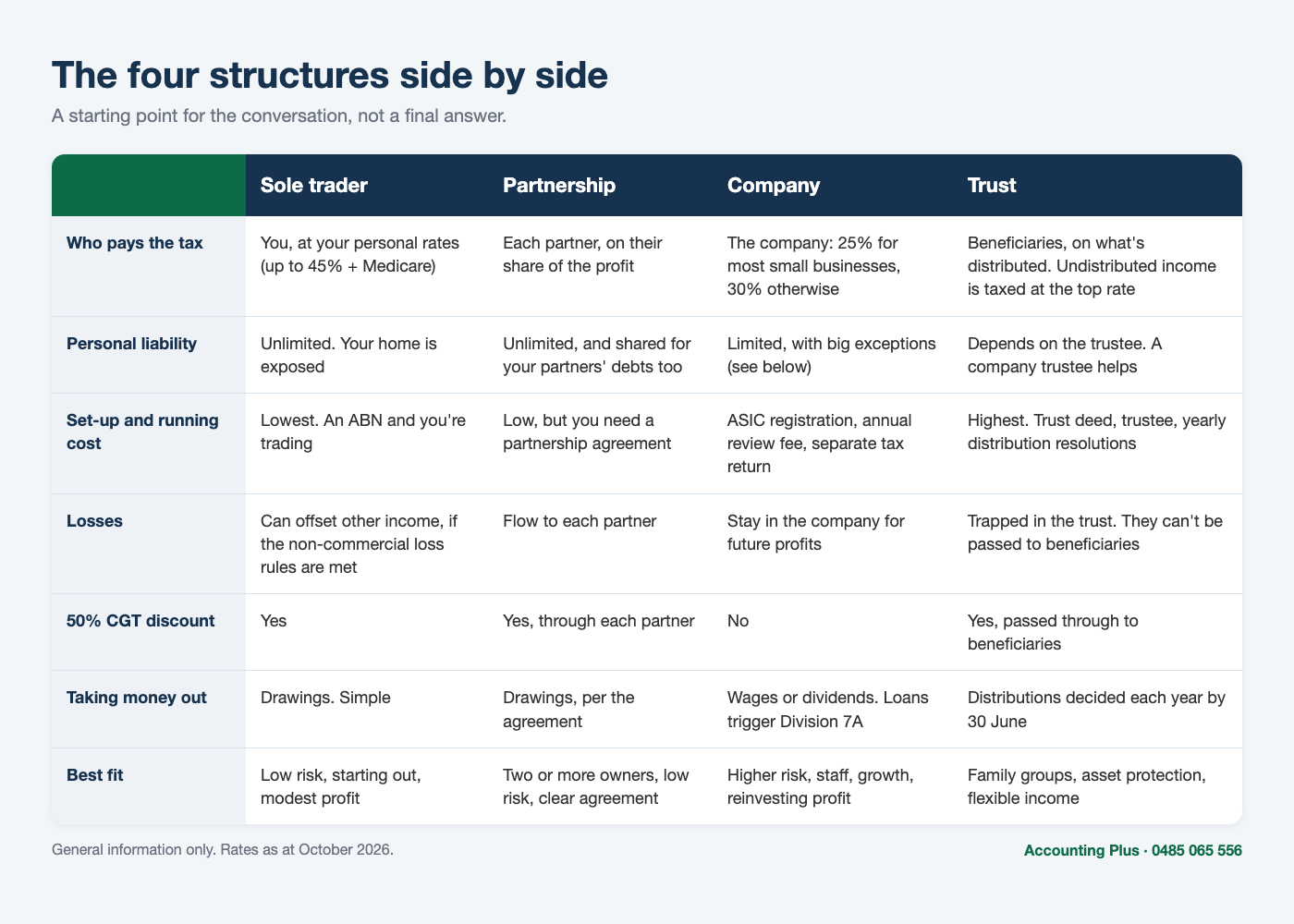
The simplest and cheapest way to start. You get an ABN, use your own tax file number, and the business profit goes on your personal tax return. You keep full control and the paperwork is light.
The catch is that you and the business are the same legal person. Every business debt is your debt, and your home and savings are exposed if something goes wrong. Profit is taxed at your personal rates, which climb to 45% plus the Medicare levy. That's fine at modest profit, but it gets expensive as the business grows.
Suits: low-risk work, the early stage, modest profit, one owner.
Partnership
Two or more people in business together, sharing the profit. The partnership lodges its own tax return but doesn't pay tax itself. Each partner pays tax on their share.
Liability is the problem. Partners are jointly and severally liable, which means you can be chased for debts your partner ran up. A written partnership agreement is essential. It should cover profit shares, who can sign for what, what happens if someone wants out, and how disputes get resolved.
Suits: two or more owners in low-risk work who trust each other and have it in writing.
Company
A company is a separate legal entity. It signs contracts, owns assets, holds the bank account and pays its own tax. Most small businesses are base rate entities and pay 25%. That's well below the top personal rate, so a company is often the better home for profit you plan to reinvest.
It costs more to run: ASIC registration, an annual review fee, a separate tax return, proper records, and a Director ID for every director. Getting money out also takes care. It comes out as wages or dividends. Money you simply take out can be caught by Division 7A and taxed as an unfranked dividend. Companies also miss out on the 50% CGT discount that individuals and trusts get.
Suits: higher-risk work, employers, growing businesses, profit you'll reinvest, future investors or a sale.
"Limited liability" has limits
This is where a lot of owners get caught, and it's what we see most often when a business gets into trouble. A company protects you from some business debts, but not all of them.
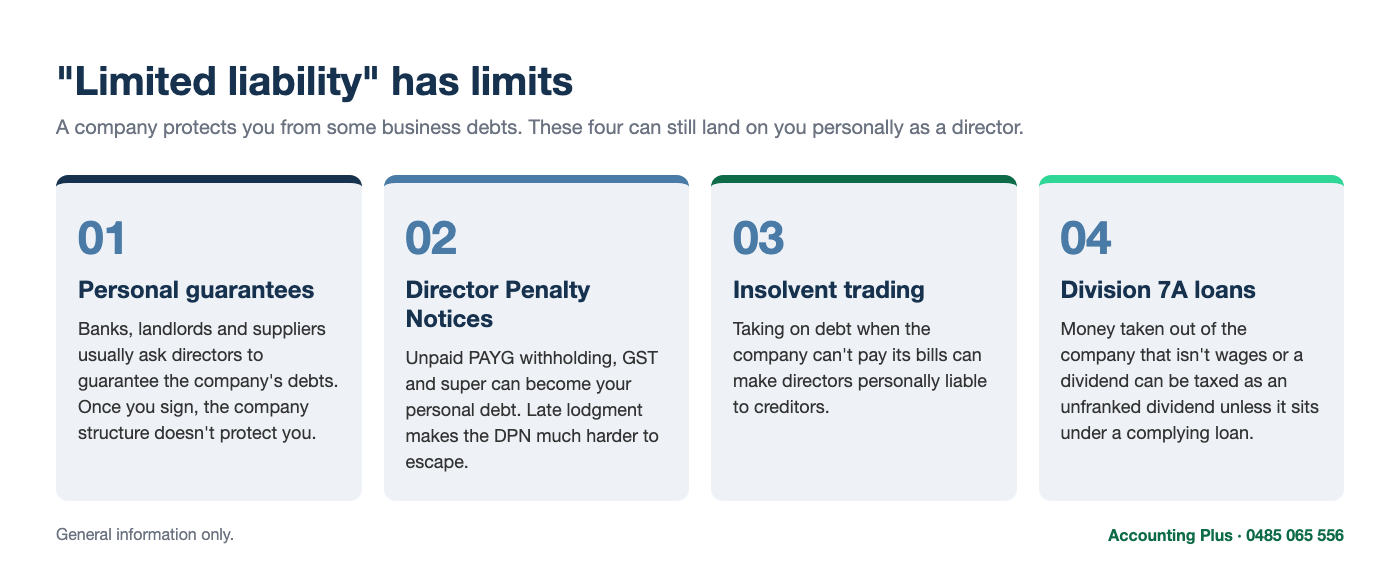
- Personal guarantees. Banks, landlords and major suppliers will usually ask directors to guarantee the company's debts. Once you've signed, the company doesn't protect you on that debt.
- Director Penalty Notices. Unpaid PAYG withholding, GST and super can be turned into a personal debt for each director. Lodging on time, even when you can't pay, keeps more options open.
- Insolvent trading. Directors who let the company take on debt when it can't pay its bills can be made personally liable.
- Division 7A. Money taken out of the company that isn't wages or a dividend can be taxed in your hands unless it's under a complying loan agreement.
A company is still the right choice for many businesses. Go in knowing what it protects and what it doesn't.
Trust
In a trust, a trustee runs the business and holds the assets for the beneficiaries. A discretionary (family) trust lets the trustee decide each year who receives the income, which can spread it across family members on lower tax rates. Trusts can also help protect assets, and beneficiaries keep access to the 50% CGT discount.
They're the most complex and expensive option. You need a trust deed and a trustee, and many people use a company as trustee to limit liability. Distributions must be decided by 30 June every year. Income that isn't distributed is taxed at the top rate. Losses stay trapped in the trust and can't be passed to beneficiaries to offset their other income. Personal services income rules can also stop you diverting income that's really earned by your own work.
Suits: family-run businesses, owners with assets to protect, and businesses with profit to share flexibly.
Eight questions to answer before you choose
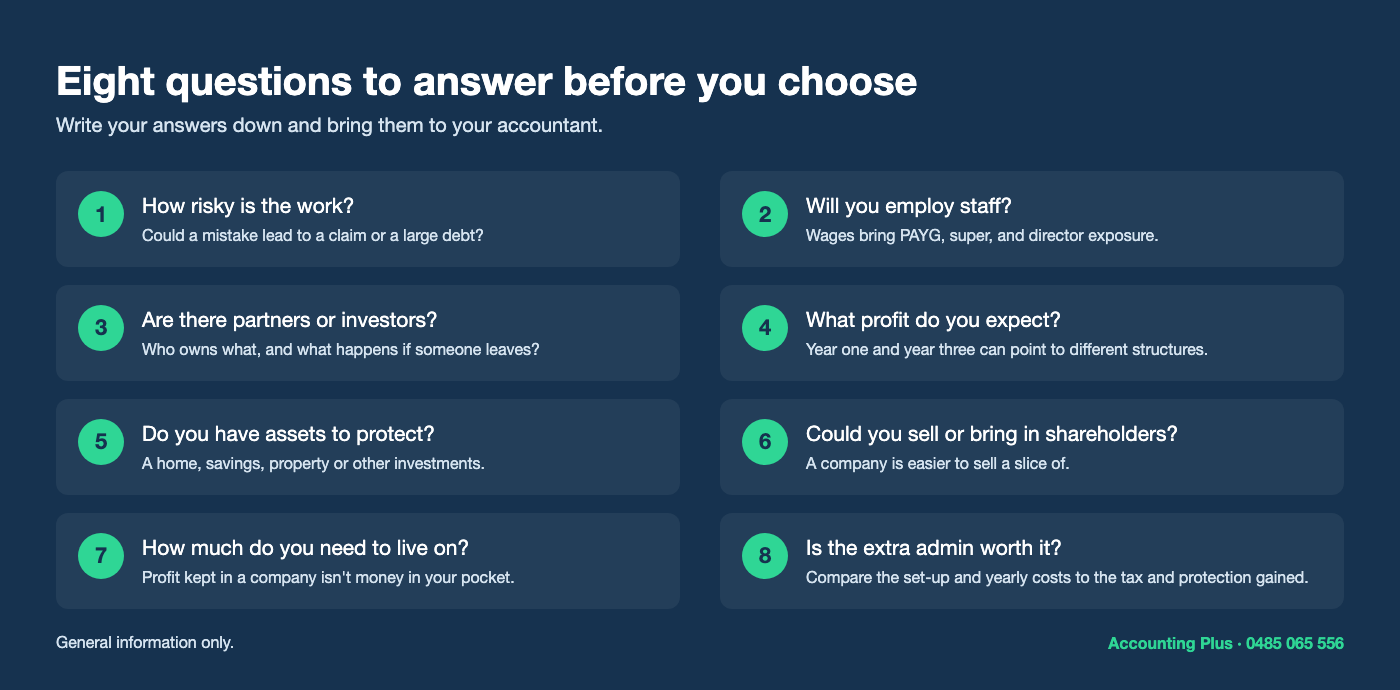
- How risky is the work, and could a mistake lead to a claim or a big debt?
- Will you employ staff?
- Are there partners or investors, now or later?
- What profit do you expect in year one, and in year three?
- Do you have a home, savings or property to protect?
- Could you sell the business or bring in shareholders?
- How much do you need to draw to live on?
- Are the set-up and yearly costs worth the tax and protection you gain?
Starting simple and changing later
Plenty of owners start as sole traders to keep costs down and move to a company once the profit or the risk justifies it. That works, but changing isn't free. You may need a new ABN, a new GST registration, new bank accounts, contracts, insurance and licences. Moving assets across can trigger capital gains tax and stamp duty. Some tax rollovers can help small businesses restructure, but they come with conditions.
The opposite mistake is just as common: setting up a company and trust on day one for a business that earns $40,000 a year. The admin and accounting costs swallow whatever the structure saves.
Pick a structure that suits where the business is now and where it will be in two or three years, and review it as things change.
Official reference
The government's plain-English guide is a good place to start: business.gov.au: Business structures.
Talk it through before you register
We look at your numbers, your risk and your plans, then recommend a structure and set it up properly: ABN, company or trust, GST, Xero and your first year's ATO obligations. If you're already trading and wondering whether your structure still fits, we'll review that too.
Call 0485 065 556 or visit accountingplus.com.au.
General information only, current as at October 2026. It is not advice about your circumstances. Accounting Plus is a trading name of Resolve Accounting Plus Pty Ltd, ABN 77 168 174 310. Tax agent services are provided by Aplus Business Services Pty Ltd, registered tax agent 26349024.