Family Trusts Explained: How They Work in Australia

Family trusts get recommended at barbecues more than almost any other structure. Sometimes that advice is right. Often it isn't: the trust costs more to run than it saves, or it's set up in a way that doesn't do what the family thinks it does.
This guide covers how a family trust works in Australia, who controls it, what it has to do each year, and how to tell whether it's worth it for you.
What is a family trust?
A family trust is a discretionary trust set up to hold a family's business or investments. The trust isn't a separate legal person like a company. A trustee holds the assets and runs the trust for the benefit of a group of beneficiaries, usually family members and related companies.
"Discretionary" is the important word. Each year the trustee decides who receives the trust's income and capital, and how much each person gets. That flexibility is the main reason people use one.
The trust usually doesn't pay tax itself. The income is distributed to beneficiaries, and each beneficiary pays tax on their share at their own rate.
Who does what
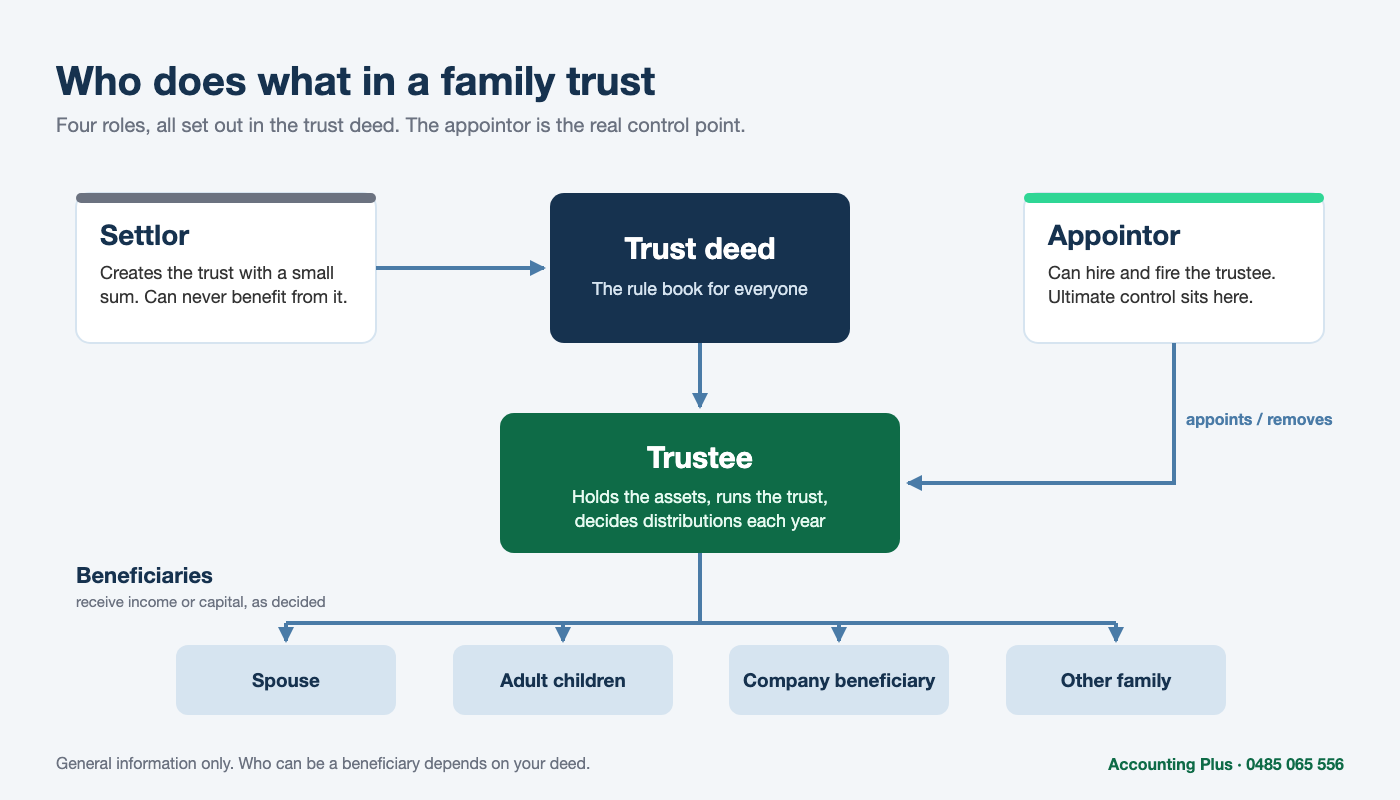
- Settlor. Creates the trust by giving the trustee a small sum, often $10. The settlor is usually someone outside the family, such as the accountant, and must never benefit from the trust.
- Trust deed. The rule book. It sets out who can be a beneficiary, what the trustee can do, and how control passes on. A poorly drafted or outdated deed causes problems years later.
- Trustee. Holds the assets, signs contracts, keeps the records and decides the distributions. The trustee can be one or more people or a company. A company trustee is usually the safer choice, because an individual trustee is personally liable for the trust's debts.
- Appointor. Can remove and replace the trustee, so this is where control of the trust really sits. Think carefully about who holds this role and what happens on death, divorce or a falling-out.
- Beneficiaries. The people and entities who can receive income or capital. Being named as a beneficiary doesn't give anyone a right to a distribution. It only makes them eligible.
Why families use them
- Flexible income. Profit can be spread across adult family members, so less of it is taxed at the top rate.
- Capital gains. Beneficiaries who are individuals keep access to the 50% CGT discount on assets held for more than 12 months. A company doesn't get it.
- Asset protection. Assets owned by the trust aren't owned by you personally, which can help keep them away from a risky business or profession. The protection isn't absolute: assets moved into a trust to get them away from creditors can be clawed back.
- Succession. Control can pass to the next generation by changing the trustee and appointor, without selling or transferring every asset.
- Investment property and family businesses. Both are commonly held in a trust, often with a company as trustee.
What it has to do every year
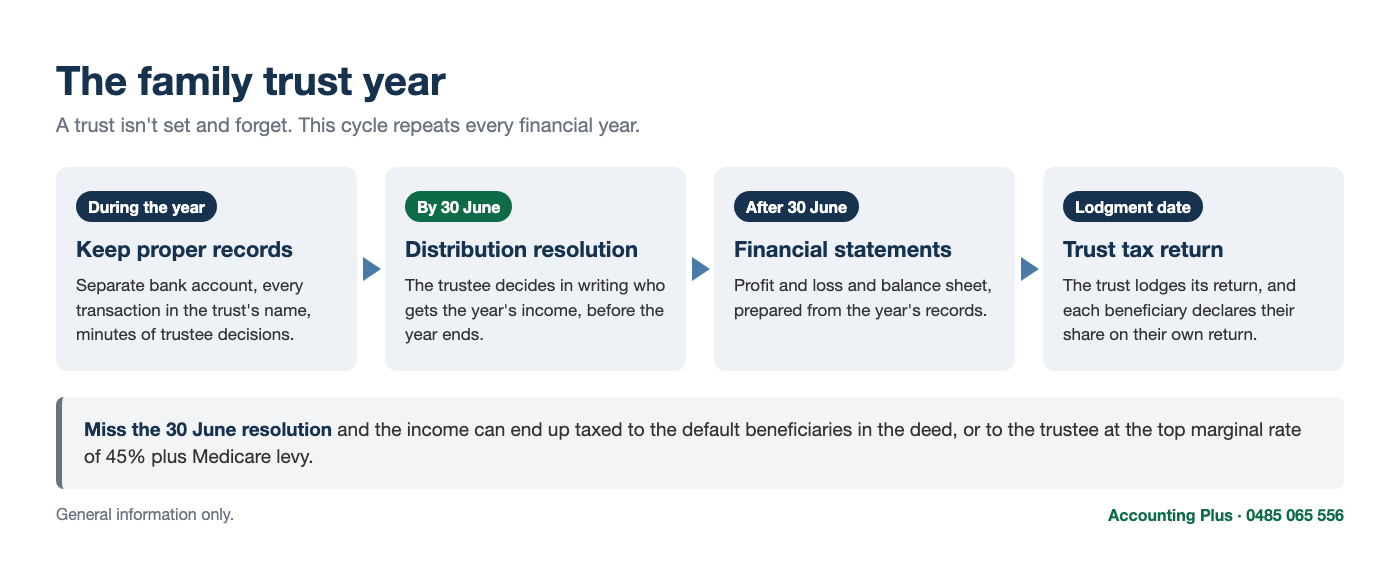
A trust is not "set and forget". Each year it needs:
- Proper records, including its own bank account, with every transaction in the trust's name.
- A distribution resolution by 30 June. The trustee must decide in writing, before the financial year ends, who is entitled to the year's income. This is the step most often missed.
- Financial statements prepared from those records.
- A trust tax return, plus each beneficiary declaring their share on their own return.
Miss the resolution and the income may fall to the default beneficiaries named in the deed, or be taxed to the trustee at the top marginal rate of 45% plus the Medicare levy.
The traps worth knowing about
- Losses stay in the trust. A trust can't pass a loss out to beneficiaries to reduce their other income. It can only carry the loss forward against future trust income, and only if it passes the trust loss tests.
- Children under 18. Distributions to minors above a small threshold are taxed at penalty rates, so splitting income with young children rarely works.
- Section 100A. The ATO is targeting arrangements where income is distributed to a low-rate beneficiary, often an adult child, but the money actually goes to or benefits someone else. If the distribution exists only on paper, the trustee can be taxed at the top rate.
- Family trust elections. Many trusts need one to pass franking credits to beneficiaries or to use past losses. Once made, distributions outside the family group attract extra tax. It's a decision to make with your accountant, not a box to tick.
- Company beneficiaries. Distributing to a company caps the tax at the company rate, but if the trust doesn't actually pay the money, Division 7A can apply.
- Land tax. In some states, including Victoria, land held in a discretionary trust can attract higher land tax rates.
Is a family trust worth it for you?
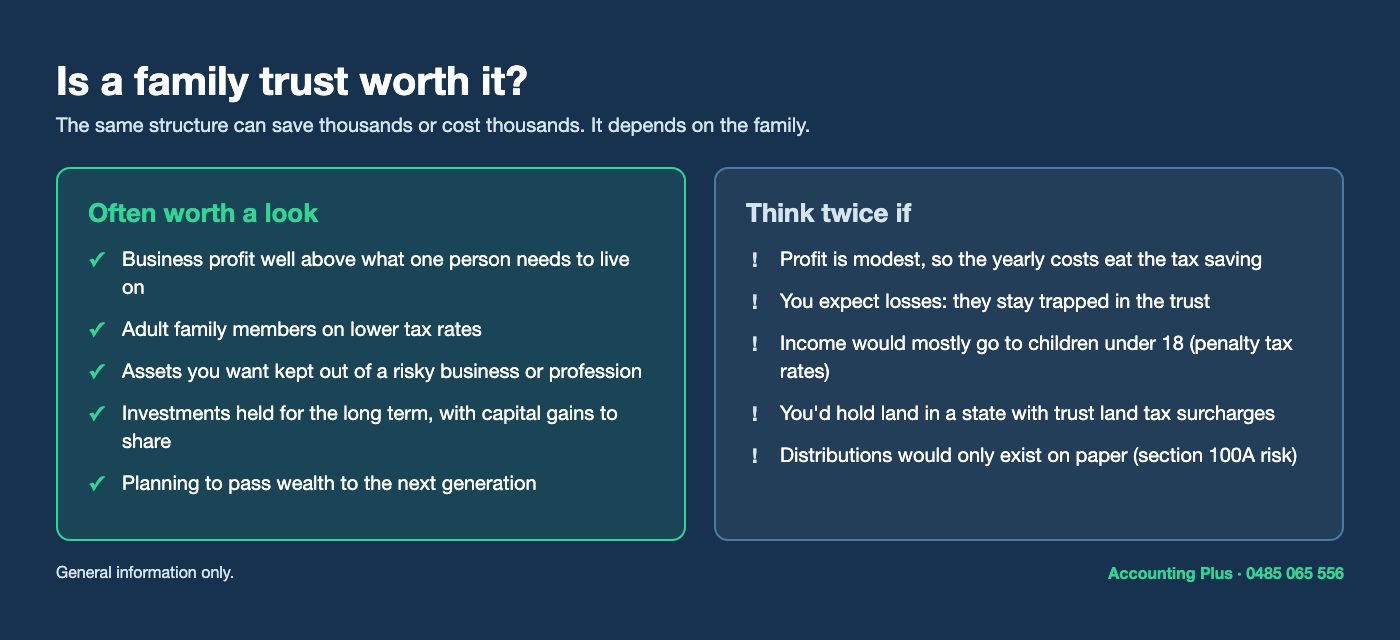
A trust adds set-up costs, a deed, possibly a trustee company, and a separate set of accounts and tax return every year. Those costs need to be weighed against the tax and protection it gives you. For a business making modest profit with one owner, the numbers often don't stack up. For a family business or investment portfolio with several adult family members and real assets to protect, they often do.
Your income, assets, family situation and long-term plans all matter. Get the structure right before you buy the asset or start trading, because moving assets into a trust later can trigger capital gains tax and stamp duty.
Official references
Comparing structures more broadly? Read our guide Sole trader, partnership, company or trust?
Talk it through first
We'll look at your numbers and your family's situation and tell you plainly whether a trust is worth it. If it is, we set it up properly: deed, trustee company, ABN and TFN, bank account and Xero. Then we handle the yearly resolution, accounts and tax return so it stays compliant. Already have a trust? We'll check it's still doing its job.
Call 0485 065 556 or visit accountingplus.com.au.
General information only, current as at October 2026. It is not advice about your circumstances. Accounting Plus is a trading name of Resolve Accounting Plus Pty Ltd, ABN 77 168 174 310. Tax agent services are provided by Aplus Business Services Pty Ltd, registered tax agent 26349024.