Cost of Sales for Tradies: Know Your Real Margin
Most tradies know what they invoiced last quarter. Far fewer know how much of that money was really theirs once the materials, wages and subbies were paid. That gap is your cost of sales, and it's the number that tells you whether your pricing works.
This guide explains what cost of sales is, what belongs in it for a trade business, and how a few simple numbers show you what happens to your profit when work picks up, slows down or costs go up.
What cost of sales actually means
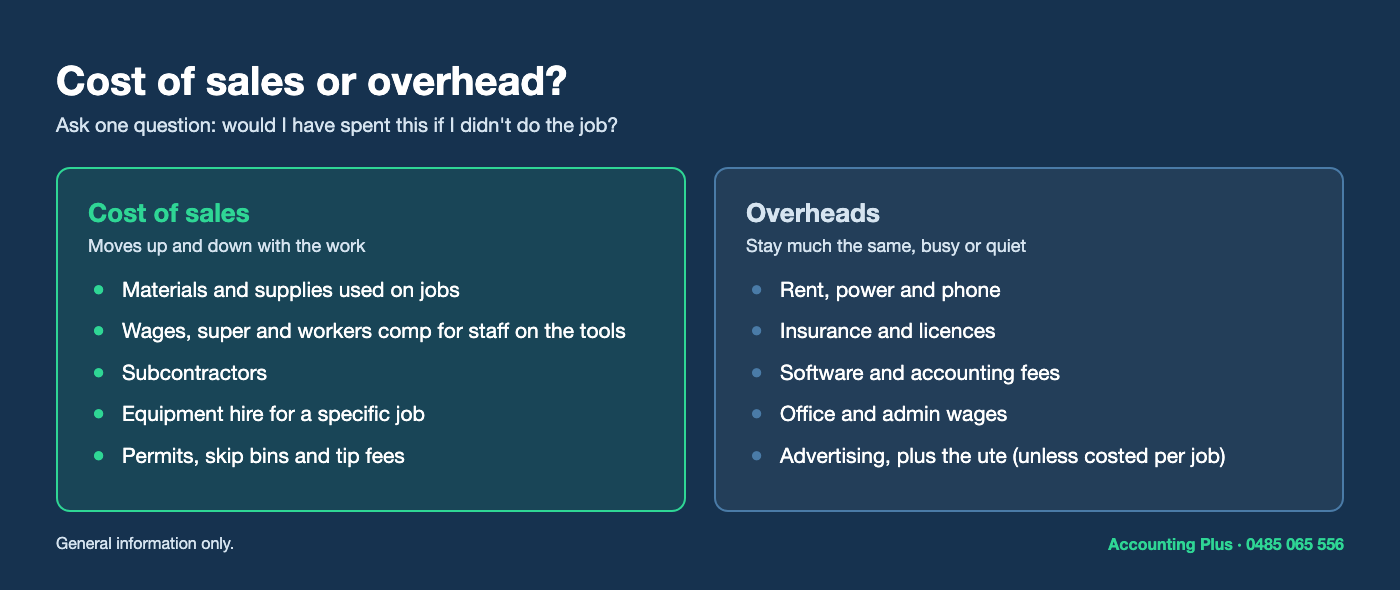
Cost of sales (sometimes called cost of goods sold or direct costs) is what it costs you to do the jobs you've been paid for. If you didn't do the job, you wouldn't have spent the money.
Everything else, the costs you carry whether you do one job this month or twenty, is an overhead (also called operating expenses).
What goes in cost of sales for a tradie
- Materials and supplies used on jobs: timber, cable, pipe, fittings, paint, concrete.
- Wages for staff on the tools, including their super and workers comp, because those costs rise and fall with the work.
- Subcontractors you bring in for a job.
- Equipment hire for a specific job: scissor lifts, excavators, scaffolding.
- Job-specific costs like permits, skip bins and tip fees.
Rent, insurance, phone, software, accounting fees, advertising and office wages are overheads. Your ute is usually an overhead too, unless you track its costs job by job.
One trap for sole traders and partners: your own time doesn't show up as a cost in your books, because what you take out is drawings, not wages. Your price still has to pay you for every hour on site, or you're working for free and calling it profit.
Sales, gross profit and net profit
Once your costs are split this way, your profit and loss tells a much clearer story:
- Sales: what you invoiced, excluding GST.
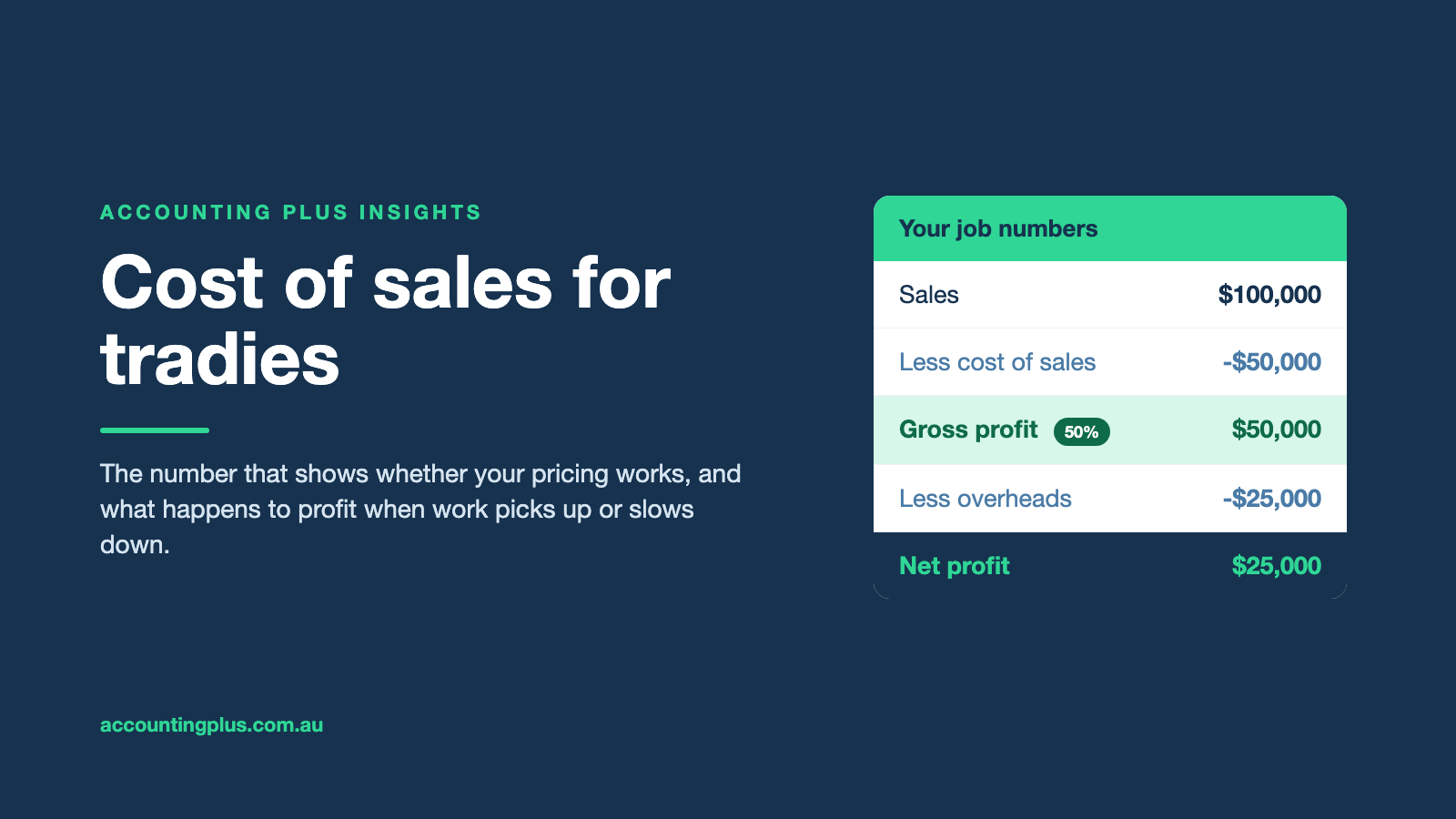
- Less cost of sales gives you gross profit: what the jobs themselves made.
- Less overheads gives you net profit: what the business made.
Gross profit as a percentage of sales is your gross margin. It's the single most useful number for a trade business, because it tells you how much of every dollar you invoice is left to cover your overheads and your profit.
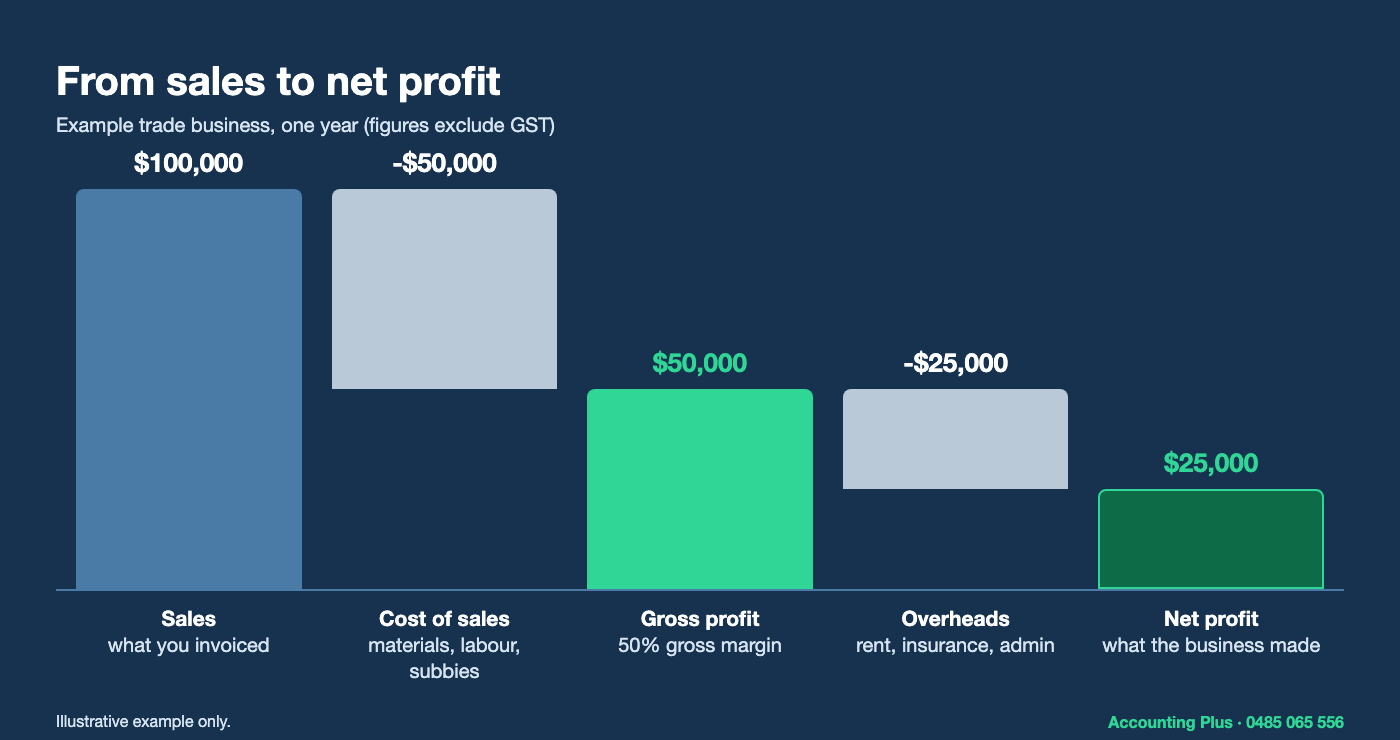
In this example, the business keeps 50 cents of every dollar after paying for the jobs. Overheads take another $25,000, leaving $25,000 net profit.
What happens when work picks up
This is where splitting your costs pays off. Cost of sales moves with your sales. Overheads mostly don't.
Say the same business doubles its sales to $200,000 at the same 50% margin. Cost of sales doubles to $100,000, but overheads stay at $25,000. Net profit jumps from $25,000 to $75,000. Sales doubled. Profit tripled.
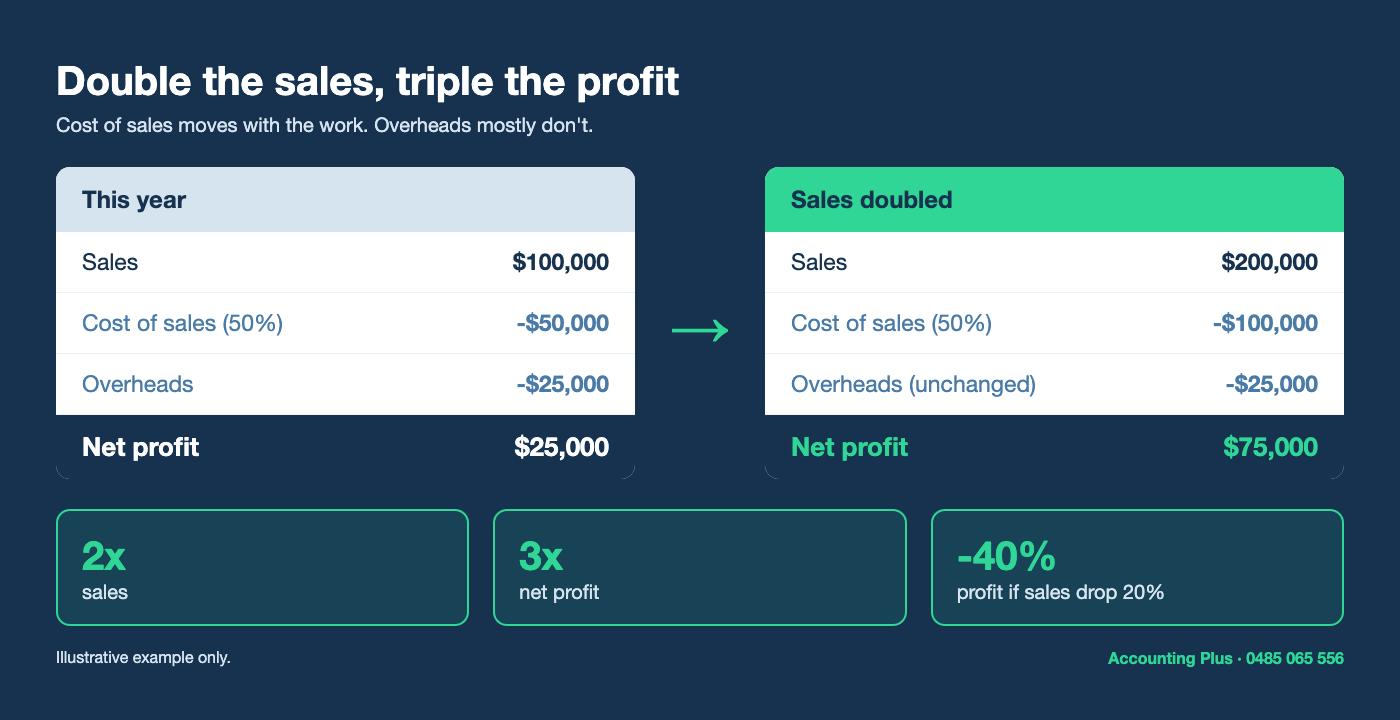
It works the other way too, which is why a quiet patch hurts more than people expect. If sales drop 20% to $80,000, cost of sales falls to $40,000 but overheads are still $25,000. Net profit falls to $15,000, a 40% drop from a 20% dip in work.
Three things your gross margin tells you
1. Your break-even point. Divide your overheads by your gross margin. With $25,000 of overheads and a 50% margin, you need $50,000 of sales before you make a dollar. Everything above that is profit.
2. Whether your pricing is keeping up. If materials and wages rise 10% and your prices don't, cost of sales in the example goes from $50,000 to $55,000. Net profit falls from $25,000 to $20,000. A small cost rise you don't pass on takes a fifth of your profit.
3. Which jobs are worth chasing. When you know the margin on each type of job, you can see which work pays and which work keeps you busy for not much. A big job at a thin margin can make less than a small one priced properly.
Getting the numbers right in your books
None of this works if job costs and overheads are mixed together. Set up separate cost of sales accounts in Xero, MYOB or QuickBooks for materials, direct wages, subcontractors and equipment hire, and code every bill to the right one as it comes in.
Then check your gross margin each month. If it's sliding, find out why before the quarter ends, not after.
Want someone to set it up and keep an eye on it?
We set up your accounts so job costs and overheads sit where they should, keep your books up to date, and go through your gross margin with you in plain English, so you can price with confidence.
Call 0485 065 556 or visit accountingplus.com.au.
Related reading: Stop Leaving Your Bookkeeping Until BAS Time.
General information only, current as at November 2026. Figures are illustrative examples. It is not advice about your circumstances. Accounting Plus is a trading name of Resolve Accounting Plus Pty Ltd, ABN 77 168 174 310. Tax agent services are provided by Aplus Business Services Pty Ltd, registered tax agent 26349024.