Tax Planning That Builds Wealth: Four Lessons From the Numbers

Business owners, property investors and high-income earners ask us the same question in different ways: how do I keep more of what I earn and turn it into long-term wealth? The answer is rarely one big trick. It's a series of decisions about timing, structure and cash flow, made with the full picture in view.
This edition covers four of them: why professional judgement still matters as AI takes over routine accounting work, how the timing of franked dividends changes your tax bill, why property ownership structures need to be compared properly, and how two people on the same income can end up with very different wealth.
1. Tax planning: why AI can't replace professional judgement
AI is taking over a lot of routine accounting work. It has never been easier to prepare and lodge a tax return. What AI can't do is exercise professional judgement.
Take a common question: are your share or crypto activities investments, taxed under the capital gains rules, or are you carrying on a business of trading? There's often no simple yes or no. The answer depends on a mix of factors:
- how often you buy and sell, and in what volume
- your intention and strategy
- whether you keep business-like records
- how organised and systematic the activity is
The two treatments produce very different results. An investor may get the 50% CGT discount on assets held for more than 12 months. A trader generally doesn't, but can usually deduct losses against other income. Getting the classification wrong can cost real money, or attract the ATO's attention.
Tax law often sets out principles rather than a formula. Sometimes more than one treatment is reasonably open, and knowing where the boundaries sit makes a significant difference to the outcome. AI can find information and run calculations. A good tax professional interprets the rules, applies them to your facts, and helps you make an informed decision within the law.
Knowing the rules matters. Knowing how to apply them is where the value is.
2. Business tax tip: could the timing of franked dividends make a $47,000 difference?
When you pay a franked dividend can matter as much as how much you pay.
Say your company earns $100,000 profit. As a base rate entity it pays 25% company tax, leaving $75,000 to distribute as a fully franked dividend with $25,000 of franking credits attached.
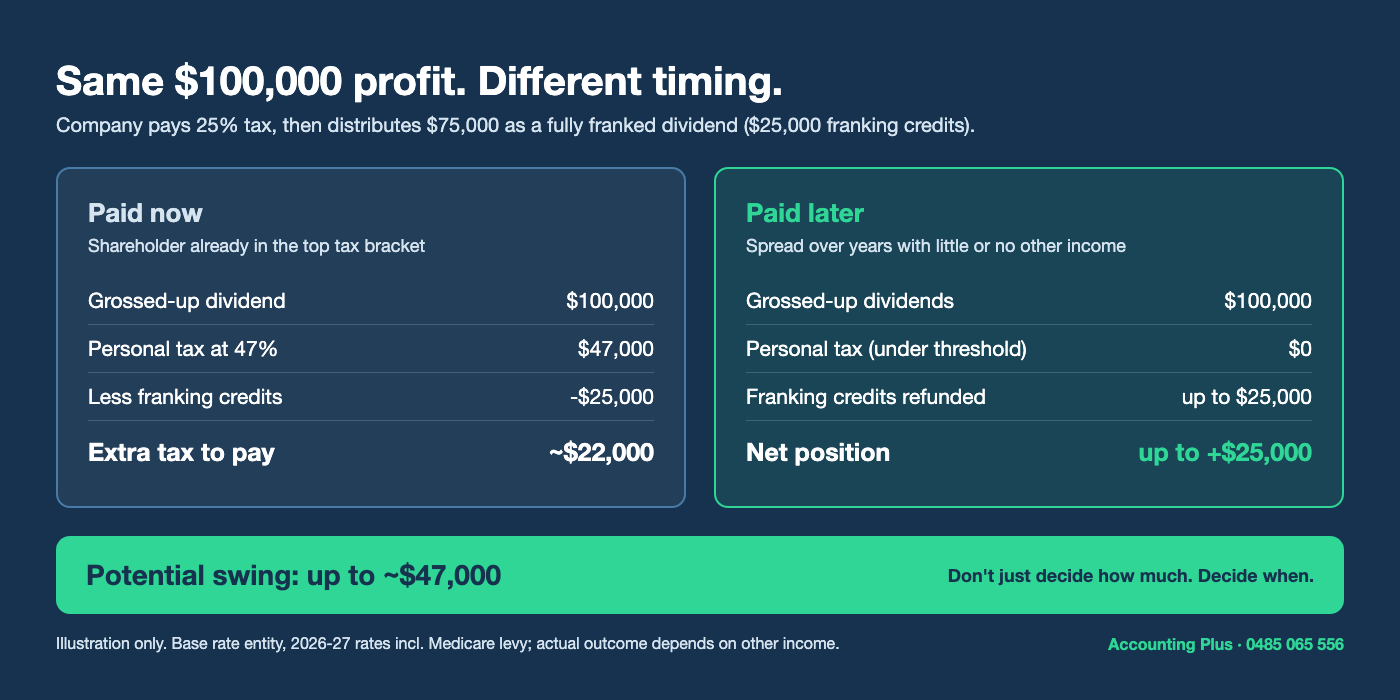
- Paid now, in a top-rate year. The shareholder already earns over $190,000, so the grossed-up $100,000 is taxed at 47% (including the Medicare levy). After the $25,000 franking credit, about $22,000 of extra personal tax is payable.
- Paid later, spread over low-income years. The company retains and reinvests the after-tax profit. The dividends are paid gradually in future years when the shareholder has little or no other taxable income, for example after selling the business or in retirement. Kept under the tax-free threshold each year, the personal tax can fall to nil, and the excess franking credits, up to $25,000, may be refunded.
That's a swing of up to around $47,000 on the same $100,000 of profit. The exact figure depends on the shareholder's other income, how the dividends are spread, and the rates in force at the time.
The lesson: don't only decide how much dividend to pay. Decide when to pay it. Retaining profits in a company brings its own rules to manage, including Division 7A if the company lends money to shareholders, so plan the timing as part of a wider strategy. Good tax planning isn't always about changing what you earn. Sometimes it's about when you take it.
3. Property wealth tip: the $93,000 mistake when choosing an ownership structure
The right ownership structure for an investment property isn't only about how much tax you pay this year. The wrong choice can cost tens of thousands of dollars in long-term wealth.
In a recent property tax consultation, we modelled a property held for 20 years under different ownership structures. At the time of sale, the modelling showed:
- Individual ownership: about $560,000 net wealth generated
- Company ownership: about $452,000 net wealth generated
- Company ownership, including the future benefit of franking credits: about $645,000
On those figures alone, the company looks like the better choice. But there's another factor: the time value of money. A dollar of tax benefit received in 20 years is worth far less than a dollar today.
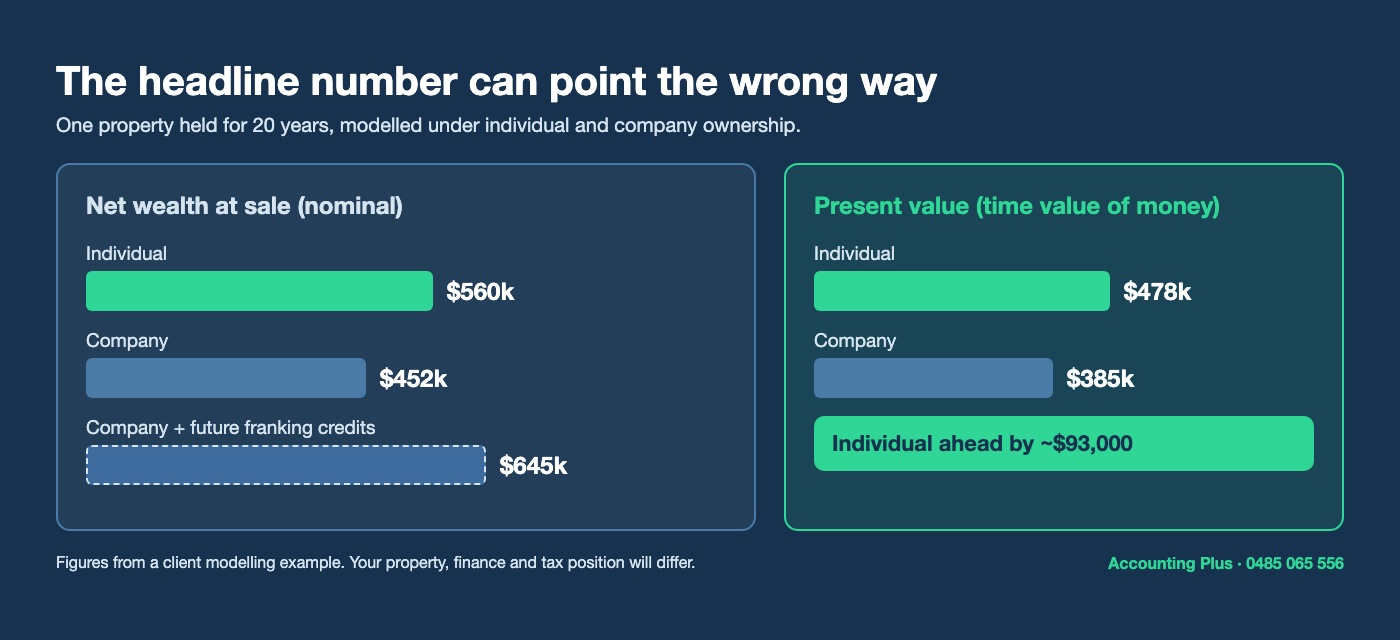
Once we allowed for when each cash flow and tax benefit was actually received over the full period, the present value of the projected wealth became:
- Individual ownership: about $478,000
- Company ownership: about $385,000
That's a difference of about $93,000 in favour of individual ownership, the reverse of what the headline figures suggested.
The lesson: when you choose a structure for a long-term property investment, don't compare today's tax rates or the final amount at sale. A proper analysis looks at every future cash flow, the tax on each one, when it arrives, and the time value of money. The structure that appears to save the most tax isn't always the one that builds the most wealth. Structures are hard to change later, because moving a property between owners can trigger capital gains tax and stamp duty, so model it before you buy.
4. Wealth planning: why two people earning $300,000 can end up with very different wealth
Two people can each earn $300,000 a year and, 20 years later, one can be far wealthier than the other.
- Person A doesn't do much planning. After tax, living costs and other expenses, they invest $30,000 a year.
- Person B earns exactly the same but takes a strategic approach to tax, investment structures, debt and cash flow. As a result they invest $50,000 a year.
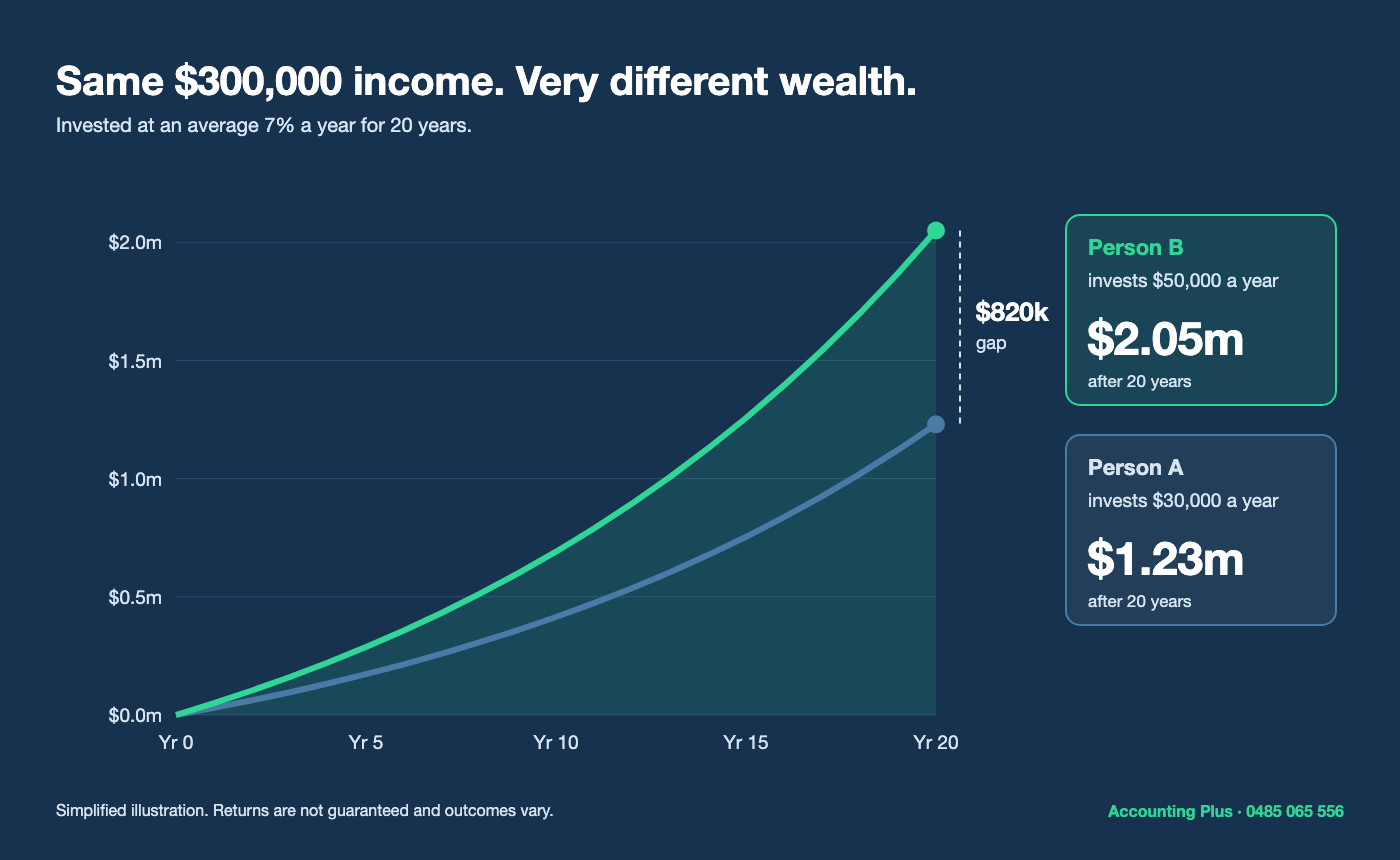
Assuming both earn an average 7% a year on their investments:
- Person A's $30,000 a year grows to about $1.23 million after 20 years.
- Person B's $50,000 a year grows to about $2.05 million.
That's a gap of around $820,000, on identical incomes. It's a simplified illustration: real returns, tax outcomes and circumstances vary. But it makes the point. Wealth isn't set by income alone. It's set by how much of that income you keep, how you structure it, and what you do with it next. Small gains in tax efficiency and cash flow, invested and compounded over many years, add up to a very large difference.
Earning $300,000 is one thing. Turning it into wealth is another.
The common thread
Each of these examples comes back to the same idea: legally minimising tax and making informed decisions with the whole picture in view, including timing, structure and the long term. Raise them with your adviser before your next business, property or investment decision, not after it.
Weighing up a structure for a business or property? Read our guides Sole trader, partnership, company or trust? and Family trusts explained.
Talk to us before you decide
We'll look at your income, your structures and your plans, model the options with real numbers, and tell you plainly what we'd do. That covers dividend timing, property ownership, and the tax planning that frees up more of your income to invest.
Call 0485 065 556 or visit accountingplus.com.au.
General information only, current as at November 2026. The figures are illustrations based on stated assumptions and are not a forecast or advice about your circumstances. Tax rates and thresholds change. Accounting Plus is a trading name of Resolve Accounting Plus Pty Ltd, ABN 77 168 174 310. Tax agent services are provided by Aplus Business Services Pty Ltd, registered tax agent 26349024.