Don't Wait Until Tax Time
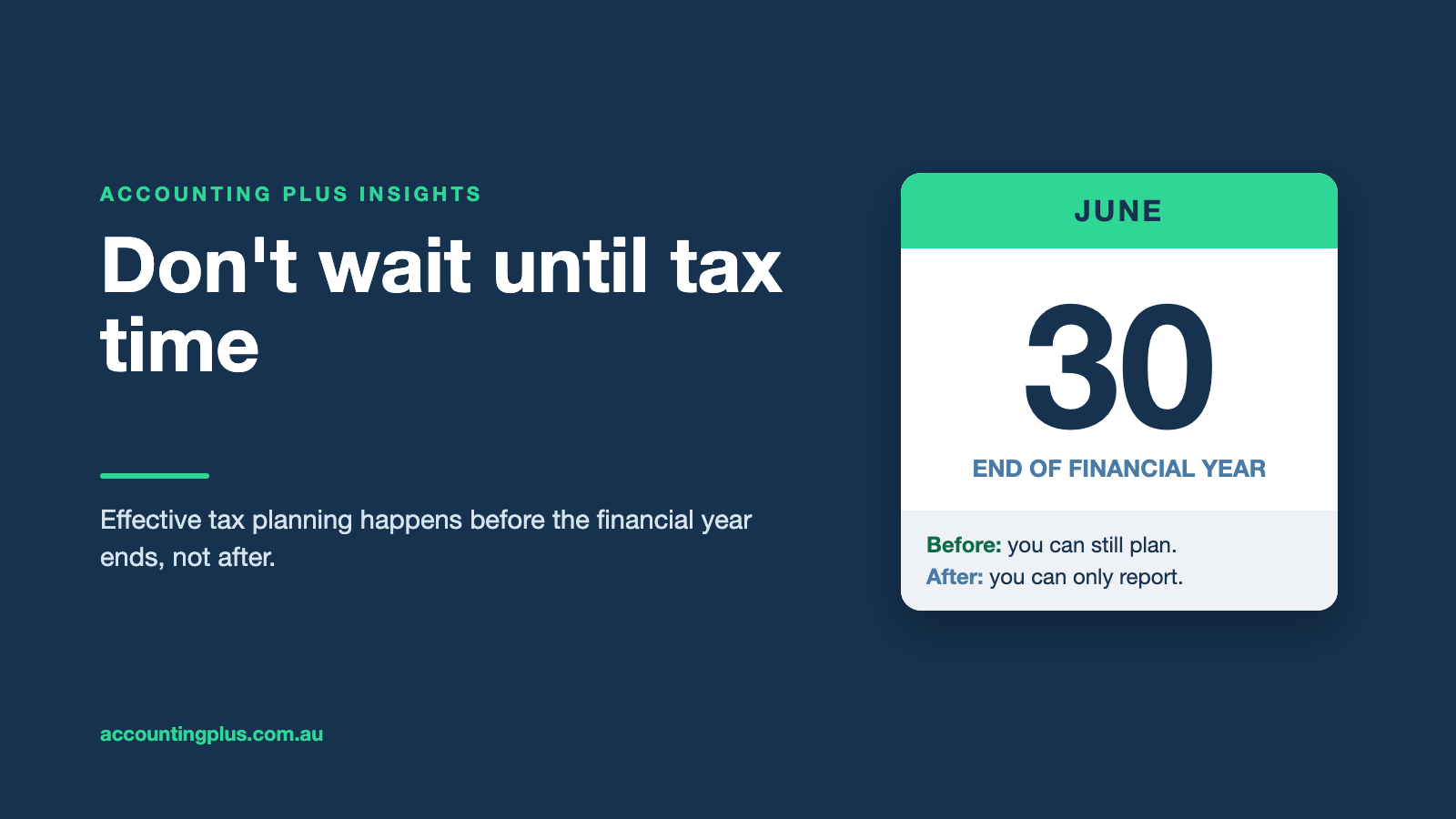
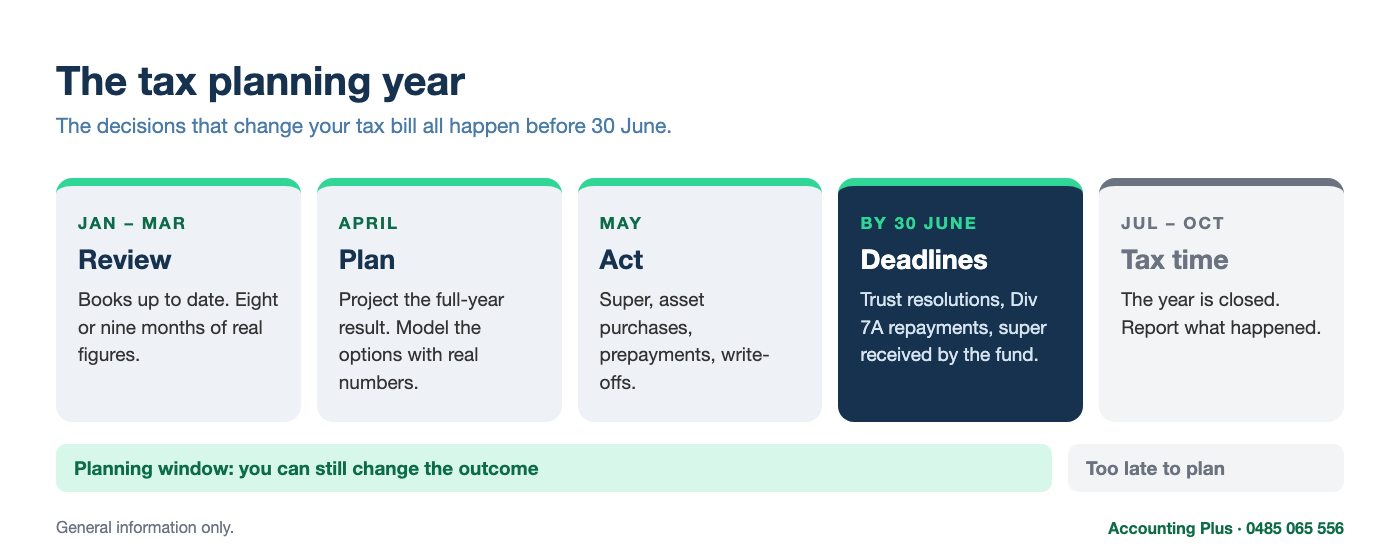
Effective tax planning happens before the financial year ends, not after. By the time most business owners sit down with their accountant in August or September, the year is closed. The numbers are history, and the only job left is to report them.
That's compliance, not planning. The decisions that change your tax bill have to be made while there's still time to act on them: before 30 June.
Why tax time is too late
Most of the legitimate ways to reduce tax depend on timing. A super contribution counts in the year your fund receives it. An asset is only claimable once it's installed and ready to use. A trust distribution needs a resolution by 30 June. A bad debt has to be written off before year end.
Miss the date and the opportunity doesn't move to next year. It's gone. When the books are finalised months later, all your accountant can do is tell you what you owe.
What you can still do before 30 June
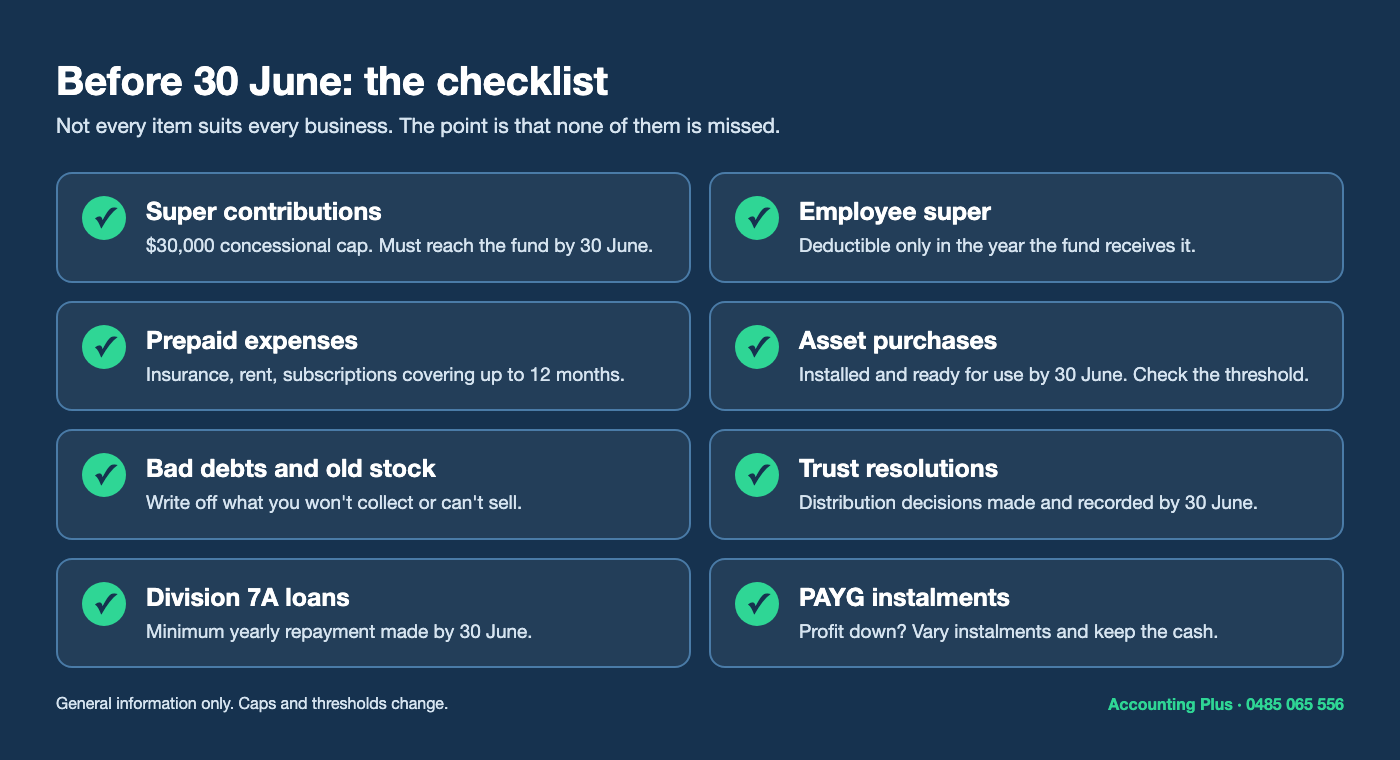
Every business is different, and not all of these will suit you. But these are the levers we look at with clients in the lead-up to year end:
- Super contributions. Concessional contributions, including employer super, are capped at $30,000 a year. If you have unused cap from earlier years and a total super balance under $500,000, you may be able to contribute more. The fund has to receive the money by 30 June.
- Employee super. Super for your staff is only deductible in the year the fund receives it, so don't leave the June payment to the last day.
- Prepaid expenses. Small businesses can generally claim prepayments, such as insurance, rent or subscriptions, covering up to 12 months.
- Asset purchases. If you were going to buy equipment anyway, timing matters. To claim it this year, it must be installed and ready for use by 30 June. The write-off thresholds change from year to year, so check before you buy.
- Bad debts and old stock. Write off debts you won't collect, and review stock that's obsolete or damaged. Both need to be dealt with before year end.
- Trust distributions. Trustees must decide how income will be distributed by 30 June. A late resolution can leave the trustee taxed at the top rate.
- Division 7A loans. If you've borrowed from your company, the minimum yearly repayment has to be made by 30 June, or the loan can be treated as an unfranked dividend.
- PAYG instalments. If this year's profit is down, you may be able to vary your instalments and keep the cash in the business.
None of these is about spending money just to save tax. Buying something you don't need to save 25 cents in the dollar still leaves you 75 cents worse off. The aim is to time decisions you were going to make anyway, and to make sure nothing available to you is missed.
What one decision can be worth
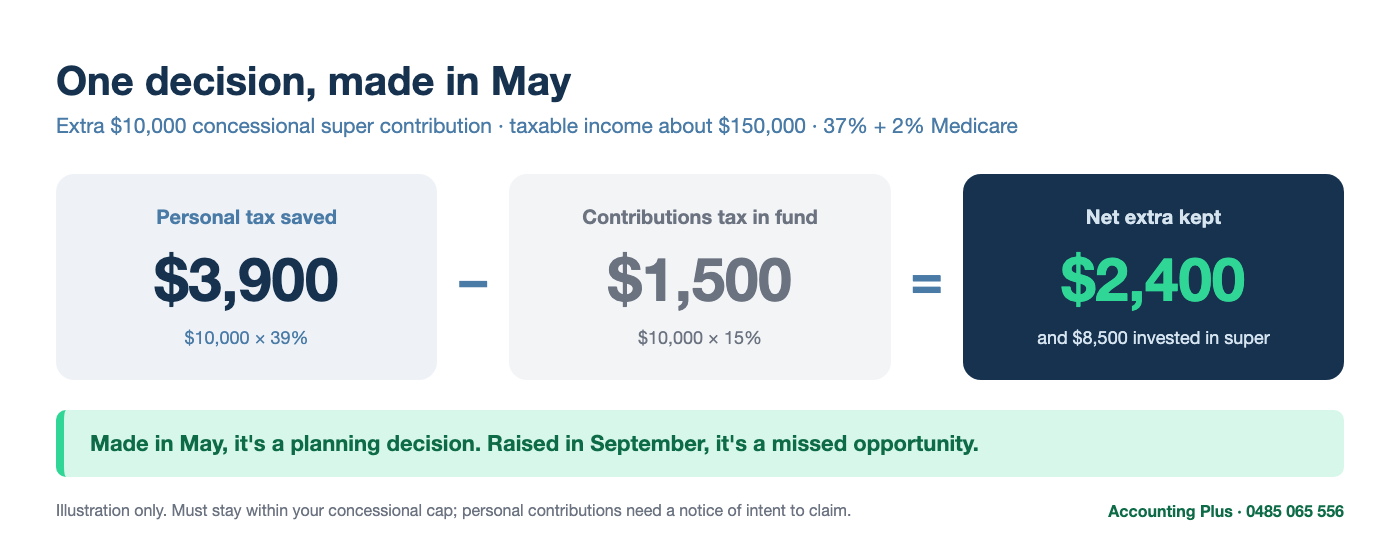
Here's a simple example. A business owner is heading for a taxable income of around $150,000. At that level, their marginal rate is 37%, plus the 2% Medicare levy.
In May, they make an extra $10,000 concessional super contribution, within their cap, and claim it as a deduction.
- Personal tax saved: about $3,900
- Contributions tax paid inside the fund (15%): $1,500
- Net extra kept: about $2,400, and the full $10,000 less contributions tax is working for them in super
Made in May, that's a planning decision. Raised in September, it's a missed opportunity.
Bigger than one year: structure and wealth
Year-end planning is the short game. The long game is whether your business structure still fits. A sole trader earning well into six figures, or a company paying out every dollar as wages, may be paying more tax than it needs to year after year. Structure changes take time to set up properly, which is another reason to start the conversation early.
We cover this in more detail in Sole trader, partnership, company or trust? and Tax planning that builds wealth.
When to start
The best time is the March quarter, once you have eight or nine months of figures. That gives enough data to project the full-year result and enough time to act on it. If your books aren't up to date, that's the first job, because you can't plan from numbers you don't have. See Stop leaving your bookkeeping until BAS time.
Book a free initial consultation
At Accounting Plus, we help business owners across Australia find tax-saving opportunities, improve their business structures and build long-term wealth. We'll look at where your year is heading, show you the options with real numbers, and tell you plainly what we'd do.
Book a free phone call or book a video consult. Prefer to talk now? Call 0485 065 556.
General information only, current as at November 2026. The example is an illustration based on stated assumptions and is not advice about your circumstances. Contribution caps, thresholds and tax rates change; check eligibility before acting. Accounting Plus is a trading name of Resolve Accounting Plus Pty Ltd, ABN 77 168 174 310. Tax agent services are provided by Aplus Business Services Pty Ltd, registered tax agent 26349024.